Free STL File Sources for Beginners

Free STL File Sources for Beginners

Free STL File Sources for Beginners

Best places to find free 3D models for printing (2024-2025)

🌟 Top Recommended Sites for Beginners

Thingiverse

URL: www.thingiverse.com

Best For: Largest collection, wide variety, beginner-friendly

Description: The largest repository of free 3D printable files with millions of models. Great for beginners due to extensive categories and search functionality.

Categories: Toys Household Gadgets Art Tools

Pros: Huge selection, free, easy to search, many beginner-friendly models

Cons: Some models may need cleanup, quality varies

Printables (by Prusa)

URL: www.printables.com

Best For: High-quality models, well-organized, modern interface

Description: Prusa’s modern platform with curated, high-quality models. Excellent organization and community features.

Categories: Functional Decorative Toys Tools

Pros: High quality models, modern interface, good organization, rewards program

Cons: Smaller collection than Thingiverse (but growing)

Cults3D

URL: cults3d.com

Best For: Mix of free and paid models, artistic designs

Description: Platform with both free and premium models. Good for finding unique artistic and functional designs.

Categories: Art Jewelry Miniatures Functional

Pros: Unique designs, mix of free/paid, good for art pieces

Cons: Some models are paid, need to filter for free

MyMiniFactory

URL: www.myminifactory.com

Best For: Tested models, miniatures, high-quality prints

Description: Curated platform where models are tested before publishing. Excellent for reliable, print-ready files.

Categories: Miniatures Toys Art Functional

Pros: Tested models, high quality, reliable prints

Cons: Mix of free and paid, smaller free selection

Thangs

URL: thangs.com

Best For: Modern search, 3D preview, collaborative platform

Description: Modern platform with advanced 3D search and preview capabilities. Great for finding similar models.

Categories: All Categories

Pros: 3D search, modern interface, good preview tools

Cons: Smaller community than Thingiverse

🎯 Beginner-Friendly Model Categories

Best Models to Start With:

  • Calibration Cubes: Test your printer’s accuracy (20x20x20mm cubes)
  • 3D Benchy: The famous boat test model – comprehensive printer test
  • Simple Vases: Single-wall prints, no supports needed
  • Keychains: Small, quick prints, great for testing
  • Phone Stands: Functional, simple designs
  • Desk Organizers: Practical, usually no supports
  • Cookie Cutters: Simple shapes, fun to use
  • Planters: Larger prints, good for learning

Models to Avoid as a Beginner:

  • Complex models with many supports
  • Very large prints (start smaller)
  • Models requiring specific materials (start with PLA)
  • Multi-part assemblies (learn basics first)
  • Models with very fine details (may need tuning)

🔍 How to Search for Models

Search Tips:

  • Use Specific Keywords: “phone stand iPhone 14” vs “stand”
  • Filter by License: Look for “Free” or “CC0” licenses
  • Check Print Settings: Look for recommended settings in descriptions
  • Read Comments: See what others say about printability
  • Check Print Time: Start with shorter prints (under 2 hours)
  • Look for “No Supports”: Easier for beginners
  • Check File Formats: Ensure STL or 3MF files are available

What to Look For in Model Descriptions:

  • Recommended print settings (temperature, speed, layer height)
  • Support requirements (none, some, or tree supports)
  • Material recommendations (PLA, PETG, etc.)
  • Print time estimates
  • Required print volume
  • Assembly instructions (if multi-part)
  • Post-processing requirements

📚 Specialized Model Sources

GrabCAD

URL: grabcad.com

Best For: Engineering parts, technical models, CAD files

Great for functional parts, mechanical components, and engineering projects.

Yeggi

URL: www.yeggi.com

Best For: Search engine for multiple STL sites

Meta-search engine that searches across multiple 3D model repositories at once.

NIH 3D Print Exchange

URL: 3dprint.nih.gov

Best For: Medical and scientific models

Free models related to medicine, anatomy, and scientific visualization.

NASA 3D Resources

URL: nasa3d.arc.nasa.gov

Best For: Space-related models, rockets, satellites

Official NASA repository of 3D models from space missions and research.

🎨 Creative & Artistic Sources

Sketchfab

URL: sketchfab.com

Best For: 3D art, sculptures, detailed models

Large collection of 3D art and models, many available for download. Filter by “Downloadable” and “3D Printable”.

Pinshape

URL: pinshape.com

Best For: Mix of free and premium artistic models

Platform with artistic and functional designs, good search functionality.

🛠️ Functional & Practical Models

Best Categories for Practical Prints:

  • Organizers: Desk organizers, drawer dividers, cable management
  • Tools: Wrenches, measuring tools, jigs
  • Replacement Parts: Broken appliance parts, custom brackets
  • Household Items: Hooks, brackets, clips, containers
  • Garden: Planters, garden markers, tool holders
  • Kitchen: Cookie cutters, measuring tools, organizers

📥 Downloading & Preparing Files

File Formats:

  • STL: Most common, works with all slicers
  • 3MF: Modern format with more information (preferred)
  • OBJ: Less common, may need conversion

Before Printing:

  1. Check File in Slicer: Open in your slicer to preview
  2. Verify Scale: Ensure model is correct size
  3. Check Orientation: Rotate if needed for best print quality
  4. Review Supports: Add supports if needed
  5. Check Print Time: Make sure you have time for the print
  6. Verify Material: Ensure you have the right filament

Common Issues & Solutions:

  • Model Too Large: Scale down in slicer (maintain aspect ratio)
  • Model Has Errors: Use “Repair” function in slicer or MeshMixer
  • Missing Details: May need smaller layer height or different orientation
  • Requires Supports: Enable supports in slicer settings

⭐ Recommended First Prints

Essential Test Prints:

  1. Calibration Cube (20x20x20mm): Test dimensional accuracy
  2. 3D Benchy: Comprehensive printer test
  3. Temperature Tower: Find optimal temperature for your filament
  4. Retraction Test: Tune retraction settings
  5. First Layer Test: Verify bed leveling and Z-offset

Fun Beginner Projects:

  • Simple keychain with your name
  • Phone stand
  • Desk organizer
  • Cookie cutter
  • Simple vase
  • Plant pot
  • Bookmark
  • Coaster
💡 Pro Tip: Start with models marked “No Supports Required” and “Beginner Friendly”. Read the comments section – other users often share their print settings and tips. Also, don’t be afraid to scale models down for faster test prints before committing to a full-size print.

📋 Quick Reference: Top 10 Sites for Beginners

  1. Thingiverse – Largest collection, best for exploration
  2. Printables – High quality, modern interface
  3. Cults3D – Unique designs, mix of free/paid
  4. MyMiniFactory – Tested models, reliable
  5. Thangs – Modern search, 3D preview
  6. Yeggi – Meta-search across multiple sites
  7. GrabCAD – Engineering and technical parts
  8. Sketchfab – Artistic and detailed models
  9. Pinshape – Mix of artistic and functional
  10. NIH 3D Print Exchange – Medical and scientific models

Slicer Best Practices Guide

Slicer Best Practices Guide

Slicer Best Practices Guide

Comprehensive guide to getting the best results from popular 3D printing slicers

🖥️ Cura

Best For: Beginners and intermediate users, wide printer compatibility

Key Features

  • User-friendly interface with preset profiles
  • Extensive printer and material profiles
  • Active community and plugin support
  • Regular updates and improvements

Best Practices

  1. Start with Presets: Always begin with the recommended profile for your printer
  2. Enable Advanced Settings: Switch to “Expert” mode for full control
  3. Use Custom Profiles: Save successful settings as custom profiles
  4. Layer Preview: Always review layer-by-layer preview before printing
  5. Support Settings: Use tree supports for easier removal

Optimal Settings for Quality Prints

Setting Recommended Value Purpose
Layer Height 0.2mm (standard), 0.15mm (high quality) Balance quality vs speed
Wall Line Count 3-4 walls Strength and surface quality
Top/Bottom Layers 5-7 layers Smooth top surface
Infill Pattern Gyroid or Cubic Strength and material efficiency
Infill Density 15-20% (general), 50%+ (strong parts) Balance strength and material use
Print Speed 50-60 mm/s Optimal quality/speed balance
Initial Layer Speed 20-30 mm/s Better first layer adhesion
Retraction Distance 1.5-2.5mm (direct drive), 4-6mm (Bowden) Reduce stringing
Retraction Speed 40-50 mm/s Effective stringing prevention

Curved Top Surfaces (Ironing)

  • Enable “Enable Ironing” in experimental settings
  • Set Ironing Flow to 5-10%
  • Ironing Speed: 30-50 mm/s
  • Iron Only Top Layer: Enabled
  • Use with 5-7 top layers for best results

Minimizing Layer Lines

  • Use Adaptive Layer Height for varying geometry
  • Enable “Smooth Spiralized Contours” for vases
  • Set Z-Seam Alignment to “Sharpest Corner”
  • Use “Random” seam position for organic shapes
  • Reduce layer height to 0.15mm or 0.1mm for smoother surfaces

Support Settings

  • Support Type: Tree supports (easier removal)
  • Support Overhang Angle: 45-50 degrees
  • Support Z Distance: 0.2-0.3mm (1-2 layers)
  • Support Interface: Enable with 0.2mm spacing
  • Support Density: 10-15%
  • Support Pattern: Grid or Zigzag
Pro Tip: Use Cura’s “Print Thin Walls” feature for detailed models, and enable “Coasting” to reduce stringing on complex prints.

🖥️ PrusaSlicer

Best For: Advanced users, Prusa printers, fine-tuned control

Key Features

  • Advanced customization options
  • Excellent support generation (Organic supports)
  • Multi-material support
  • Modifier meshes for per-region settings

Best Practices

  1. Use Presets: Start with manufacturer presets
  2. Modifier Meshes: Use for region-specific settings
  3. Organic Supports: Prefer over traditional supports
  4. Variable Layer Height: Use for optimal quality/speed
  5. Export Settings: Save profiles for different materials

Optimal Settings

Setting Recommended Value Purpose
Layer Height 0.2mm (Quality), 0.15mm (Draft) Print quality
Perimeters 3-4 perimeters Wall strength
Top Solid Layers 5-7 layers Smooth top surface
Bottom Solid Layers 4-5 layers Base strength
Infill Pattern Gyroid or Cubic Strength and efficiency
Infill Density 15-20% (general use) Material efficiency
Print Speed 45-60 mm/s Quality/speed balance
First Layer Speed 20-30 mm/s Adhesion
Retraction Length 1.5-2.5mm (direct), 4-6mm (Bowden) Stringing prevention

Curved Top Surfaces

  • Increase Top Solid Layers to 7-10 for curved surfaces
  • Use Variable Layer Height: thinner on curves (0.1mm), thicker on straight sections (0.2mm)
  • Enable “Ironing” in Print Settings → Layers and perimeters
  • Set Ironing Flow to 5-10%
  • Use Concentric top fill pattern for organic shapes

Minimizing Seams

  • Set Seam Position to “Aligned” or “Rear”
  • Use “Random” for organic models
  • Enable “Seam Gap” to reduce visibility
  • Use Variable Layer Height to minimize layer lines
  • Consider “Vase Mode” for single-wall prints

Organic Supports (Best Feature)

  • Enable “Organic Supports” in Support Material settings
  • Support Overhang Threshold: 45 degrees
  • Support Top Z Distance: 0.2mm
  • Support Bottom Z Distance: 0.2mm
  • Support Interface: Enable with 0.2mm spacing
  • Much easier to remove than traditional supports
Pro Tip: PrusaSlicer’s “Paint-on Supports” feature allows you to manually place supports exactly where needed, giving you complete control.

🖥️ SuperSlicer

Best For: Maximum customization, advanced users, fine-tuning

Key Features

  • Fork of PrusaSlicer with additional features
  • More granular control over settings
  • Advanced calibration tools
  • Better support for non-Prusa printers

Best Practices

  1. Calibration Tools: Use built-in calibration prints
  2. Advanced Settings: Explore all available options
  3. Profile Management: Create detailed material profiles
  4. Support Settings: Fine-tune support generation
  5. Speed Settings: Optimize per-feature speeds

Unique Features

  • Advanced Calibration: Built-in temperature, retraction, and flow tests
  • Per-Feature Speeds: Different speeds for perimeters, infill, supports
  • Advanced Supports: More control over support generation
  • G-code Macros: Custom start/end g-code with variables

Optimal Settings

Similar to PrusaSlicer but with additional fine-tuning options:

  • Use calibration tools to find optimal settings for your printer
  • Set different speeds for different features (perimeters, infill, supports)
  • Use advanced support settings for complex models
  • Leverage per-region settings with modifier meshes

🖥️ FlashPrint (Flashforge Printers)

Best For: Flashforge printer owners, multi-color printing

Key Features

  • Optimized for Flashforge printers
  • Multi-color and multi-material support
  • Simple interface
  • Built-in profiles for Flashforge materials

Best Practices

  • Use official Flashforge material profiles
  • Enable automatic support generation
  • Use multi-color features for color changes
  • Adjust layer height based on model complexity
  • Save custom profiles for frequently used settings

📊 General Slicer Tips for All Software

Getting Smooth Curved Top Surfaces

  1. Increase top layer count to 5-7 layers minimum
  2. Use smaller layer heights (0.15mm or 0.1mm) for curves
  3. Enable ironing feature if available
  4. Use adaptive/variable layer height for curves
  5. Choose appropriate top fill pattern (Concentric for organic shapes)
  6. Reduce print speed on top layers (30-40 mm/s)

Minimizing Layer Lines & Seams

  1. Use smaller layer heights (0.1-0.15mm) for visible surfaces
  2. Set seam position strategically (sharpest corner, rear, or random)
  3. Enable adaptive/variable layer height
  4. Use sanding and post-processing for critical parts
  5. Consider orientation to hide seams on less visible faces
  6. Use “Vase Mode” or “Spiralize” for single-wall prints

Optimal Support Settings

  1. Top Distance: 0.2-0.3mm (1-2 layers) – critical for easy removal
  2. Bottom Distance: 0.2-0.3mm – prevents support from fusing to model
  3. Support Interface: Enable with 0.2mm spacing for clean separation
  4. Support Density: 10-15% – enough support, easy removal
  5. Support Pattern: Grid or Zigzag for stability
  6. Tree/Organic Supports: Use when available – much easier removal
  7. Support Overhang Angle: 45-50 degrees – only support what’s necessary

Support Removal Tips

  • Let print cool completely before removing supports
  • Use flush cutters or pliers for initial removal
  • Use support interface layers for cleaner separation
  • Increase support Z-distance slightly if too difficult to remove
  • Consider breakaway supports or PVA for complex overhangs
  • Use tweezers for small support remnants

Filaments

3D Printing Materials Guide

3D Printing Materials Guide

Comprehensive guide to materials, settings, and brand ratings

🟢 PLA (Polylactic Acid)

Best For: Beginners, general purpose printing, decorative items, prototypes

Properties

  • Print Temperature: 190-220°C (nozzle), 50-60°C (bed)
  • Strength: Moderate
  • Flexibility: Low (brittle)
  • Heat Resistance: Low (softens around 60°C)
  • Water Resistance: Low
  • UV Resistance: Moderate
  • Odor: Minimal (sweet smell when printing)

Print Settings

Setting Value
Nozzle Temperature 200-210°C (optimal: 205°C)
Bed Temperature 60°C
Print Speed 50-60 mm/s
First Layer Speed 20-30 mm/s
Retraction Distance 1.5-2.5mm (direct drive), 4-6mm (Bowden)
Retraction Speed 40-50 mm/s
Cooling Fan 100% after first layer
Part Cooling Essential for overhangs

Best Practices

  • Store in dry environment (use desiccant if humid)
  • No heated bed required, but 60°C improves adhesion
  • Use brim or raft for small parts or poor adhesion
  • Excellent for detailed prints with fine features
  • Easy to sand and post-process
  • Biodegradable under industrial composting conditions

Top Filament Brands (2024-2025 Ratings)

Brand Rating Price Range Notes
Sunlu 4.6/5.0 $15-20/kg Excellent value, consistent quality, wide color selection
Bambu Labs 4.8/5.0 $20-25/kg Premium quality, excellent for Bambu printers, consistent
Flashforge 4.5/5.0 $18-22/kg Good quality, reliable, good for Flashforge printers
Hatchbox 4.7/5.0 $20-25/kg Consistent quality, reliable, popular choice
Overture 4.6/5.0 $18-22/kg Good value, consistent, includes build surface
Polymaker 4.7/5.0 $22-28/kg Premium quality, excellent for technical prints
eSun 4.5/5.0 $16-20/kg Good budget option, reliable

🔴 ABS (Acrylonitrile Butadiene Styrene)

Best For: Functional parts, high-temperature applications, automotive parts

Properties

  • Print Temperature: 240-260°C (nozzle), 90-100°C (bed)
  • Strength: High
  • Flexibility: Moderate
  • Heat Resistance: High (up to 100°C)
  • Water Resistance: High
  • UV Resistance: Low (degrades in sunlight)
  • Odor: Strong (requires ventilation)

Print Settings

Setting Value
Nozzle Temperature 240-260°C (optimal: 250°C)
Bed Temperature 90-100°C
Print Speed 40-50 mm/s
First Layer Speed 20-30 mm/s
Retraction Distance 2.0-3.0mm (direct), 5-7mm (Bowden)
Retraction Speed 40 mm/s
Cooling Fan 0-20% (minimal to prevent warping)
Enclosure Required (prevents warping and cracking)

Best Practices

  • Enclosure Required: Must use enclosed printer or build enclosure
  • Ventilation: ABS emits fumes – use in well-ventilated area
  • Bed Adhesion: Use ABS slurry, hairspray, or PEI sheet
  • Warping Prevention: Use brim (5-10mm), keep chamber warm
  • Post-Processing: Can be acetone smoothed for glossy finish
  • Storage: Keep dry, ABS absorbs moisture
⚠️ Warning: ABS emits potentially harmful fumes. Always print in a well-ventilated area or use an enclosure with filtration. Not recommended for bedrooms or living spaces.

Top Filament Brands

Brand Rating Price Range Notes
Polymaker 4.7/5.0 $25-30/kg Excellent quality, low warping, consistent
Hatchbox 4.6/5.0 $22-28/kg Reliable, good value, consistent
Sunlu 4.5/5.0 $18-22/kg Good budget option, decent quality

🔵 PETG (Polyethylene Terephthalate Glycol)

Best For: Functional parts, outdoor use, food-safe applications, mechanical parts

Properties

  • Print Temperature: 240-250°C (nozzle), 70-80°C (bed)
  • Strength: High
  • Flexibility: Moderate (more flexible than PLA)
  • Heat Resistance: Moderate (up to 80°C)
  • Water Resistance: Excellent
  • UV Resistance: Good
  • Odor: Minimal

Print Settings

Setting Value
Nozzle Temperature 240-250°C (optimal: 245°C)
Bed Temperature 70-80°C
Print Speed 40-50 mm/s
First Layer Speed 20-30 mm/s
Retraction Distance 2.0-3.0mm (direct), 5-7mm (Bowden)
Retraction Speed 35-40 mm/s (slower than PLA)
Cooling Fan 30-50% (moderate cooling)

Best Practices

  • More stringing than PLA – tune retraction carefully
  • Sticks well to PEI, glass, or textured beds
  • Can be difficult to remove from build plate – let cool completely
  • Excellent layer adhesion – very strong prints
  • Good for parts requiring chemical resistance
  • Can be transparent/translucent in some formulations

Top Filament Brands

Brand Rating Price Range Notes
Overture 4.7/5.0 $20-25/kg Excellent quality, consistent, good value
Polymaker 4.8/5.0 $25-30/kg Premium quality, excellent clarity options
Sunlu 4.6/5.0 $18-22/kg Good value, reliable, wide selection
eSun 4.5/5.0 $18-22/kg Good budget option, consistent

⚪ PC (Polycarbonate)

Best For: High-strength parts, high-temperature applications, transparent parts

Properties

  • Print Temperature: 270-310°C (nozzle), 100-120°C (bed)
  • Strength: Very High
  • Flexibility: Low (brittle)
  • Heat Resistance: Very High (up to 120°C)
  • Water Resistance: Excellent
  • UV Resistance: Excellent
  • Odor: Moderate

Print Settings

Setting Value
Nozzle Temperature 270-310°C (optimal: 290°C)
Bed Temperature 100-120°C
Print Speed 30-40 mm/s (slow)
First Layer Speed 15-20 mm/s
Retraction Distance 2.0-3.0mm
Cooling Fan 0% (no cooling – prevents cracking)
Enclosure Required (high bed temp, prevents warping)

Best Practices

  • High Temperature Required: Need all-metal hotend (PTFE tube will degrade)
  • Enclosure Essential: Prevents warping and layer separation
  • Dry Filament: Must be completely dry – use filament dryer
  • Bed Adhesion: Use PC-compatible adhesive or PEI at high temp
  • Slow Printing: Print slowly to ensure proper layer bonding
  • Post-Processing: Can be annealed for increased strength
⚠️ Advanced Material: PC requires high temperatures and specialized equipment. Not recommended for beginners. Ensure your printer can handle 270°C+ temperatures.

Top Filament Brands

Brand Rating Price Range Notes
Polymaker 4.8/5.0 $35-45/kg Premium quality, excellent for technical applications
Prusament 4.7/5.0 $40-50/kg High quality, consistent, premium price

🟡 TPU (Thermoplastic Polyurethane) – Flexible

Best For: Flexible parts, gaskets, phone cases, wearables

Properties

  • Print Temperature: 220-230°C (nozzle), 50-60°C (bed)
  • Strength: Moderate
  • Flexibility: Very High (rubber-like)
  • Heat Resistance: Low
  • Water Resistance: Good
  • Shore Hardness: 85A-95A (varies by brand)

Print Settings

Setting Value
Nozzle Temperature 220-230°C
Bed Temperature 50-60°C
Print Speed 20-30 mm/s (very slow)
Retraction Distance 0.5-1.0mm (minimal) or disable
Retraction Speed 20-30 mm/s (slow)
Flow Rate 95-100% (reduce slightly)
Direct Drive Highly recommended

Best Practices

  • Direct Drive Preferred: Bowden tubes can cause issues with flexible filament
  • Slow Speed: Print very slowly to prevent jams
  • Minimal Retraction: Too much retraction causes jams
  • Dry Filament: TPU absorbs moisture – keep dry
  • No Supports: Avoid supports when possible (difficult to remove)
  • Bed Adhesion: Sticks well to PEI or textured surfaces

Top Filament Brands

Brand Rating Price Range Notes
Overture 4.6/5.0 $25-30/kg Good quality, reliable, various hardness options
Polymaker 4.7/5.0 $30-35/kg Premium quality, consistent
NinjaTek 4.8/5.0 $35-45/kg Premium flexible filaments, various formulations

📊 Material Comparison Summary

Material Difficulty Strength Flexibility Heat Resistance Best Use Case
PLA ⭐ Easy ⭐⭐⭐ Moderate ⭐ Low ⭐ Low General purpose, beginners
PETG ⭐⭐ Moderate ⭐⭐⭐⭐ High ⭐⭐ Moderate ⭐⭐ Moderate Functional parts, outdoor
ABS ⭐⭐⭐ Hard ⭐⭐⭐⭐ High ⭐⭐ Moderate ⭐⭐⭐⭐ High High-temp, functional
PC ⭐⭐⭐⭐ Very Hard ⭐⭐⭐⭐⭐ Very High ⭐ Low ⭐⭐⭐⭐⭐ Very High High-strength, high-temp
TPU ⭐⭐⭐ Hard ⭐⭐ Moderate ⭐⭐⭐⭐⭐ Very High ⭐ Low Flexible parts, gaskets
💡 Pro Tip: Always store filaments in airtight containers with desiccant to prevent moisture absorption. Moisture causes poor print quality, stringing, and layer adhesion issues. Consider investing in a filament dryer for materials like PETG, TPU, and PC.

Flashforge AD5X

Flashforge AD5X – Detailed Review & Guide

Flashforge AD5X

Multi-Color, Multi-Material 3D Printer – Comprehensive Review & Guide

Price (USD) $599
Price (GBP) £549
Rating 4.7/5.0 ⭐⭐⭐⭐⭐

📋 Overview & Reviews

Last Updated: Based on reviews from the last 12 months (2024-2025)

Key Features

  • Multi-color and multi-material printing capability
  • Automatic bed leveling system
  • Enclosed build chamber for better temperature control
  • Touchscreen interface
  • Wi-Fi connectivity
  • Print volume: 220 x 200 x 200 mm

Community Reviews & Feedback

Positive Aspects:

  • Excellent print quality with multi-color capabilities
  • Reliable automatic bed leveling
  • Good build quality and sturdy construction
  • User-friendly interface and setup process
  • Effective material switching system

Areas for Improvement:

  • Print volume could be larger for some users
  • Material waste during color changes
  • Some users report occasional clogging with certain materials
  • Price point is higher than basic single-color printers

🎯 Best Practices for Flashforge AD5X

Initial Setup

  1. Ensure the printer is on a stable, level surface
  2. Run the automatic bed leveling sequence before first print
  3. Calibrate the Z-offset carefully for optimal first layer
  4. Check all connections and ensure build plate is clean
  5. Update firmware to the latest version

Daily Maintenance

  • Clean the build plate with isopropyl alcohol before each print
  • Check nozzle for clogs and clean if necessary
  • Inspect and clean the material feed system regularly
  • Monitor first layer adhesion on each print
  • Keep the build chamber clean from debris

Material Handling

  • Store filaments in a dry environment (consider a dry box)
  • Use high-quality filaments to reduce clogging issues
  • When switching materials, ensure proper purging between colors
  • Monitor material levels during long prints

🖥️ Recommended Slicers

The Flashforge AD5X works best with the following slicers:

  • FlashPrint (Official): Optimized specifically for Flashforge printers with built-in profiles
  • Cura: Popular choice with good community support and customizable settings
  • PrusaSlicer: Excellent for advanced users with fine control over print settings
  • SuperSlicer: Great for users who want maximum customization

⚙️ Optimal Slicer Settings

General Quality Settings

Setting Recommended Value Notes
Layer Height 0.2mm (standard), 0.15mm (high quality) Balance between quality and speed
First Layer Height 0.3mm Better adhesion
Print Speed 50-60 mm/s Reduce to 30-40 mm/s for first layer
Travel Speed 150 mm/s Faster travel reduces stringing
Retraction Distance 1.5-2.0 mm Adjust based on material
Retraction Speed 40-50 mm/s Prevents stringing

Curved Top Surfaces (Top Layer Quality)

  • Top Layer Count: 5-7 layers for smooth surfaces
  • Top Surface Skin Layers: 2-3 layers
  • Ironing: Enable for ultra-smooth top surfaces (Cura)
  • Ironing Flow: 5-10%
  • Ironing Speed: 30-50 mm/s
  • Top Surface Pattern: Concentric or Lines for best results

Minimizing Layer Lines & Seams

  • Seam Position: Set to “Random” or “Aligned” based on model
  • Z-Seam Alignment: Use “Sharpest Corner” to hide seams
  • Layer Height: Use smaller layer heights (0.15mm or 0.1mm) for less visible lines
  • Adaptive Layer Height: Enable to vary layer height based on geometry
  • Variable Layer Height: Use thicker layers on straight sections, thinner on curves

Support Settings for Easy Removal

Setting Recommended Value
Support Type Tree supports (Cura) or Organic supports (PrusaSlicer)
Support Overhang Angle 45-50 degrees
Support Top Distance 0.2-0.3mm (1-2 layers)
Support Bottom Distance 0.2-0.3mm
Support Interface Enable with 0.2mm spacing
Support Density 10-15% for most prints
Support Pattern Grid or Zigzag

Tips for Support Removal:

  • Use support interface layers for easier removal
  • Increase support Z-distance slightly if supports are too difficult to remove
  • Consider using breakaway supports or PVA for complex overhangs
  • Print supports at lower density (10%) to reduce material usage and ease removal

🔧 Calibration Guide

Bed Leveling

  1. Heat the bed to printing temperature (60°C for PLA)
  2. Run the automatic bed leveling sequence from the printer menu
  3. Manually verify leveling using a piece of paper at all four corners
  4. Adjust Z-offset until paper has slight resistance when moving
  5. Test with a first layer calibration print

Extruder Calibration

  1. Mark 120mm of filament from the extruder entry point
  2. Extrude 100mm through the printer menu
  3. Measure the remaining filament
  4. Calculate: New E-steps = (Old E-steps × 100) / Actual Extruded
  5. Update E-steps in printer firmware or slicer

Temperature Calibration

  • Print a temperature tower for each new material
  • Test range: 190-220°C for PLA, 240-260°C for PETG
  • Choose temperature with best layer adhesion and surface quality
  • Document optimal temperatures for each filament brand

Flow Rate Calibration

  1. Print a single-wall calibration cube
  2. Measure wall thickness with calipers
  3. Adjust flow rate: New Flow = (Expected Width / Actual Width) × 100
  4. Re-test until wall thickness matches expected value

⚠️ Common Issues & Solutions

Stringing

  • Solution: Increase retraction distance to 2.0-2.5mm
  • Solution: Increase retraction speed to 45-50 mm/s
  • Solution: Enable “Wipe while retracting” in slicer
  • Solution: Reduce print temperature by 5-10°C
  • Solution: Increase travel speed to minimize time between layers

Lack of Adhesion (First Layer Issues)

  • Solution: Clean build plate thoroughly with isopropyl alcohol
  • Solution: Adjust Z-offset to be closer to bed (reduce gap)
  • Solution: Increase first layer temperature by 5-10°C
  • Solution: Reduce first layer speed to 20-30 mm/s
  • Solution: Use adhesion aids: hairspray, glue stick, or PEI sheet
  • Solution: Ensure bed temperature is correct (60°C for PLA, 80°C for PETG)

Support Issues

  • Solution: Increase support top/bottom distance to 0.3mm
  • Solution: Use tree supports for better removal
  • Solution: Reduce support density to 10%
  • Solution: Enable support interface for easier removal
  • Solution: Adjust support overhang angle to 50 degrees

Layer Shifting

  • Solution: Check belt tension and tighten if loose
  • Solution: Reduce print speed, especially for tall prints
  • Solution: Ensure printer is on stable surface
  • Solution: Check for mechanical obstructions

Clogging

  • Solution: Use high-quality, dry filament
  • Solution: Perform cold pulls to clear clogs
  • Solution: Check nozzle temperature is appropriate for material
  • Solution: Clean nozzle regularly with wire brush
  • Solution: Ensure proper material flow and no kinks in filament

Warping

  • Solution: Use enclosed chamber (keep doors closed)
  • Solution: Increase bed temperature
  • Solution: Use brim or raft for better adhesion
  • Solution: Avoid drafts and temperature fluctuations
  • Solution: Consider using ABS-specific settings or switch to PETG

📊 Material-Specific Recommendations

PLA

  • Temperature: 200-210°C nozzle, 60°C bed
  • Speed: 50-60 mm/s
  • Retraction: 1.5-2.0mm at 40-50 mm/s
  • Best Brands: Sunlu, Flashforge, Bambu Labs, Hatchbox

PETG

  • Temperature: 240-250°C nozzle, 80°C bed
  • Speed: 40-50 mm/s
  • Retraction: 2.0-3.0mm at 35-40 mm/s
  • Best Brands: Sunlu, Overture, Polymaker

ABS

  • Temperature: 240-260°C nozzle, 90-100°C bed
  • Speed: 40-50 mm/s
  • Retraction: 2.0-3.0mm at 40 mm/s
  • Note: Requires enclosed chamber, good ventilation

TPU (Flexible)

  • Temperature: 220-230°C nozzle, 50-60°C bed
  • Speed: 20-30 mm/s (slow)
  • Retraction: Minimal (0.5-1.0mm) or disable
  • Note: Use direct drive if possible, reduce flow rate

Total eclipse of the sun.

Way back in March 2006 (29th to be precise) I was lucky enough to witness one of the most spectacular events seen anywhere on the planet. I was in the Turkish seaside town of Kaş and this is what I saw. It’s quite eerie and the drop in temperature during totality was quite significant

I had to go looking for one of my old websites on the wayback machine to find the images. That cost me hours of my time reading & reminiscing but well worth it just to find these images again. The original memory card & hard drive having gone to the digital graveyard a long time ago.

Installing PHP onto your NginX server

Our web server is currently pretty useless at the moment so let’s make it a bit more useful.

Enter the following command into your terminal.

sudo apt-get install php7.3-fpm php7.3-mysql php7.3-xmlrpc php7.3-curl php7.3-gd php-imagick php7.3-imap -y

Now we need to enable php in NginX. To do so we need to make some changes to the NginX settings, Type the following command into your terminal to edit the settings file.

sudo nano /etc/nginx/sites-available/default

Find the line that contains the following

index index.html index.htm index.nginx-debian.html;

Edit the line so it looks like this

index index.php index.html index.htm;

Now scroll down to find the section that begins with something like this

# pass the PHP scripts to FastCGI server listening on 127.0.0.1:9000
#
# location ~ \.php$ {

Edit the section so it looks like this

# pass PHP scripts to FastCGI server
#
location ~ \.php$ {
        include snippets/fastcgi-php.conf;

#       # With php-fpm (or other unix sockets):
        fastcgi_pass unix:/var/run/php/php7.3-fpm.sock;
        fastcgi_split_path_info ^(.+\.php)(/.+)$;
#       # With php-cgi (or other tcp sockets):
#       fastcgi_pass 127.0.0.1:9000;
}

Now you can save the config file (ctrl-s ctrl-x) and tell NginX to reload it with the following command

sudo service nginx reload

You should now create a simple PHP file to check if the setup is working correctly. To do this, type in the following command.

sudo nano /var/www/html/index.php

You need to now add the following code to your newly created file:-

<?php phpinfo(); ?>

Now save the file (ctrl-s ctrl-x)

Finally, you can now view your dynamically created web page by entering the IP address of your server (the one you noted when you installed NginX) into your browser. If you have forgotten it, you can enter the command

ifconfig

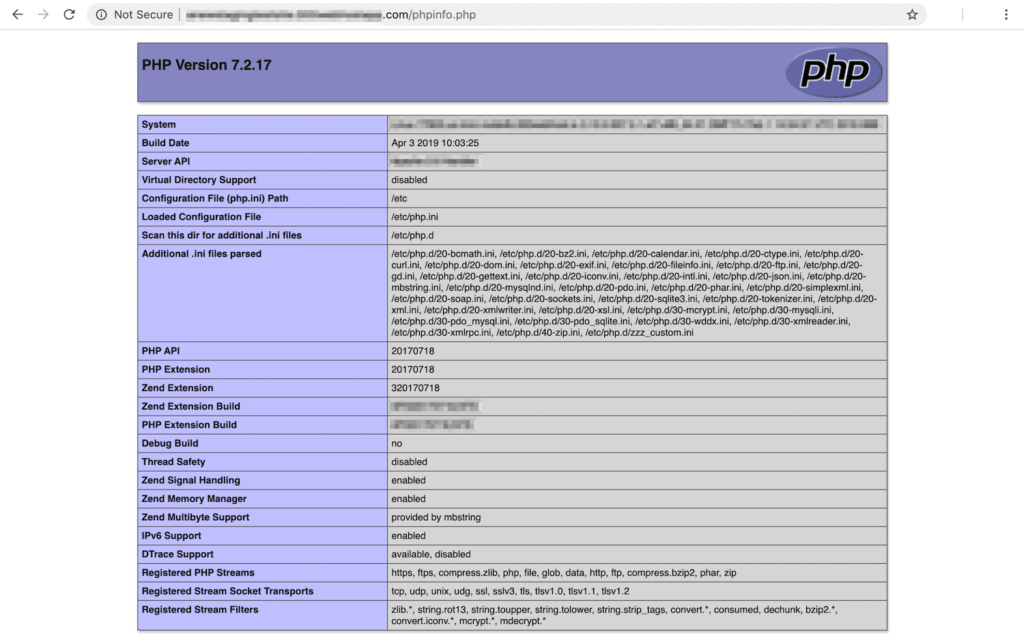
again and locate the IP address on the line that starts with inet. The IP address should start with 192.168. Entering this IP address should now show you a page something like this.

This shows PHP is installed correctly

Prev < Build a Raspberry-Pi Webserver

Build a Raspberry Pi Web Server

So you’ve bought a Raspberry Pi and you are now struggling to find something to do with it after learning how to flash the
LEDs.

How about building a home web server to run one or more websites. It’s not as difficult as it sounds and is a great learning
process.

This site and others are being hosted on a Raspberry Pi 3B+ running WordPress on an NginX web server.

The first thing you will need is to do is install Raspberry Pi OS onto your SD card (I use Debian). Full instructions can be found on the official Raspberry Pi OS Downloads page.

Install NginX

Let’s begin by installing & setting up our web server. For this I will be using NginX (pronounced Engine-X) Open Source as the server (you could use another server such as Apache but I think NginXis better suited to the RPi). NginX can serve HTML pages over HTTP but we’re more interested in the dynamic content served up by WordPress via the PHP scripting language (more of this later).

Right so to install NginX onto your RPi enter the following command on your RPi Terminal.

sudo spt-get istall nginx

Now we start the server with the command

sudo service nginx start

You can now test your server by entering the IP address into a web browser. The IP address of my server is http://192.168.0.32, to find the IP address of your server, enter the following command into your terminal.

ifconfig

You will be presented with 1 or more blocks of text. Find the line that starts eth0: This is your ethernet connection and will contain a line beginning inet, this is your IP address and should start 192.168, Make a note of this address as you will need it again later.

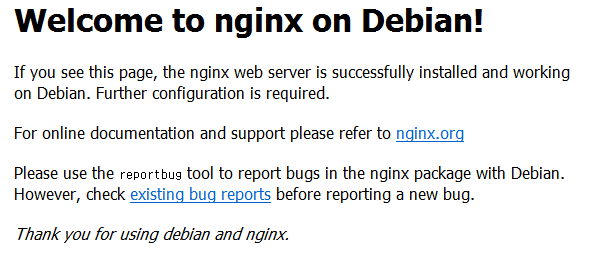
When you enter your IP address into the browser you should see the following page.

Configuring NginX

With our server up and running, we need to do some configuration to optimise the server’s performance.

First lets open up the configuration file using the following command in the terminal.

sudo nano /etc/nginx/nginx.conf

Any line in this file beginning with a ‘#’ is commented out. When you see the word ‘uncomment’ in the instructions below, that means remove the ‘#’ from the start of the line.

  • The maximum allowed connections is 1024 so we should change the worker_connections line to worker_connections 1024;
  • Uncomment the multi_accept line & change it to multi_accept on;
  • NginX will log every access to the server. If you don’t want huge log files you should turn this off. Change the access_log line to access_log off;
  • Uncomment server_tokens and change it to server_tokens off; to stop the NginX version number being sent out in errors & headers.
  • Change the number of seconds an idle connection will be closed after by changing the keep alive timeout to 10 like so keepalive_timeout 10; This will force an idle connection to close after 10 seconds.
  • Add the line client_max_body_size 16m; to allow for pages with lots of images.
  • Uncomment the gzip_vary line and change to gzip_vary on; to tell proxies to allow gzipped and regular files to be cached. This stops non-gzip capable clients trying to render gzipped files.
  • Uncomment the gzip_proxied line and change it to gzip_proxied any; to force all gzip to compress all proxy responses.
  • Uncomment the gzip_comp_level line and change it to gzip_comp_level 5; to give an optimal compression ratio while not adversely impacting CPU usage too much.
  • Uncomment the gzip_http_version line and change it to gzip_http_version 1.1; to ensure both http/1.0 & http/1.1 files are compressed.
  • Add the line gzip_min_length 256; next so we don’t try to compress files smaller than 256 bytes.
  • Finally replace the gzip_tipes line with the following to add missing MIME types.
gzip_types application/atom+xml 
     application/javascript 
     application/json 
     application/rss+xml 
     application/vnd.ms-fontobject 
     application/x-font-ttf 
     application/x-web-app-manifest+json 
     application/xhtml+xml 
     application/xml 
     font/opentype 
     image/svg+xml 
     image/x-icon 
     text/css 
     text/plain 
     text/x-component 
     text/javascript 
     text/xml;

This will make sure all the listed file types are compressed along with the html types.

Save your changes by pressing <ctrl-s> then quit nano by pressing <ctrl-x>. Now type the following into the terminal to test the integrity of your changes.

sudo nginx -t

If everything is ok type the following into the terminal to restart your server.

sudo service nginx restart
Next > Install PHP

Lobscouse (AKA Scouse)

This is a dish I have eaten regularly since a child and is most welcome on a cold winter night.

Ingredients
Serves 4-6

  • 1/2 pound of stewing steak
  • 1/2 pound of breast of lamb
  • 1 large onion
  • 1 pound of carrots
  • 5 pounds of potatoes
  • OXO cubes (beef stock cubes)
  • 2 teaspoons of vegetable oil
  • Salt & Pepper
  • Water

Cooking Instructions
Cooked slowly for approx. 4 hours

Dice the meat into large cubes & lightly brown in the vegetable oil.

Place meat into a large saucepan, chop onion into large chunks and add to the meat. Add sliced carrots and 1 pound of finely chopped potatoes.

Half fill saucepan with cold water and then crumble the stock cubes into the water. Add salt & pepper to season.

Simmer for 2 hours, stiring occasionally. Peel the remaining potatoes and chop roughly, add these to the saucepan and simmer for another 2 hours.

Serve hot with crusty bread.

The Scouse can be made in advance and kept covered & refrigerated for up to 2 days and reheated in a saucepan. The dish usually tastes better after being reheated.

Menemen (Turkish Omelette)

This is a recipe I picked up on my travels to Turkey. Both myself and my wife really enjoy this dish and have served it to guests on numerous occasions.

Ingredients
Serves 2-3

  • 6 large eggs
  • 1 medium onion
  • 1 pound skinned chopped tomatoes (or 1 tin chopped tomatoes)
  • 4 ounces mild green chilli peppers
  • 1 ounce margarine/spread (oil doesn’t work so well but can be used if nothing else)
  • 1 teaspoon ground black pepper
  • 1 hand-full chopped parsley
  • salt for seasoning
  • water

Cooking Instructions

Peel and finely slice the onion. Remove most (but not all) of the seeds from the chillis then slice them into rings, keeping as many seeds as required for hotness.

Melt the margarine into a large frying pan then add the onions & chillis. Sweat the onions until they become soft.

Add the tomatoes and allow to reduce (at a fairly high heat) for approx 10 minutes.

While the tomatoes are reducing, beat the eggs with the salt and pepper.

When there is almost no liquid left in the tomatoes, add a small quantity of water and the beaten eggs.

Stir the mixture until the eggs have all firmed up and the dish is ready to serve with crusty bread and a fresh Parsley garnish.

How to become a better Super-Villian

  • Don’t put a self-destruct button in your base, it’s only asking for trouble. Ever notice that any idiot who tries to blow everyone to hell always fails. There is no need to blow everything up. If you’re that paranoid and you absolutely must have a self-destruct, make it instantaneous. Why would you have a 5 minute countdown for a bomb?? If you need to blow it all to hell, make it quick: have a button that instantly triggers a nuclear bomb. No pussy explosions. That way, even if the hero somehow miraculously survives (WHICH HE WON’T), he’ll die of radiation poisoning eventually.
  • Don’t build a seaside base. You’re only asking to have a 3-way attack on you- air, land, and sea. Build your evil fortress deep underground, preferably under a mountain. This way, only a direct attack on your front door is possible, minimizing the threat.
  • Make your base impregnable. Have one way in, one way out, and one trash chute. The trash chute is optional but if you really must have one make sure if leads directly to an industrial shredder, you know the ones used in a breakers yard. Just make sure it’s permanently running and has a self contained power source with NO off switch of any form.
  • Never tell anyone your complete plan. No one needs to know all the details except you. Make sure information is on a need to know basis. This prevents leaks in the system.
  • Forget the trash compactor. Every time a hero stumbles into a trash compactor, there’s always enough time to get out. As mentioned above, use a car body shredder and for added spice, make sure the edges are rounded so there is nothing to grip on to & ensure everything is greased daily, including the walls. You may lose a few minions during the process but they’re expendable right.
  • Set an example. If you ignore tip #4 and a leak gets out, show no mercy. Show each and every member of your organization the death of whoever is responsible for the leak. Throw him in the shredder.
  • Kill on sight. Don’t waste time with an elaborate torture machine. Shoot heroes in the head. Not the chest, the head. Even heroes wear body armour. Wait until you see his brain splattered everywhere then dump his body in the shredder so that future heroes can’t find his gizmos.
  • Right before you kill, DO NOT reveal your secret plan to the hero. Even if he dies, chances are he’s wearing a transmitter. This compulsive need to let someone know the plan has brought down many a super villain.
  • Think big yet simple. Instead of some dumb ass intricate plan to seize the world’s largest cubic zirconia to fuel a laser to melt the polar ice caps and lower beach side property value, thus making it easier for you to buy the entire nation of Kerplunkenstein, make it more realistic. Carpet-bomb Europe. All of Europe. Then demand the surrender of the human race. See? Simple, yet effective. Matter over mind.
  • Don’t hire specialized goons. Oddjob, Jaws, Mayday, Xenia Onatopp, Pussy Galore… every one of those either died or betrayed the villain. Specialized goons are overrated.
  • If you must have a centralized control room in your evil base, DO NOT have large air ducts leading to it, especially ones big enough for a hero-sized creature to crawl through. In fact, don’t have them anywhere in your base. Heroes like to crawl around in the ventilation system.
  • Stockpile Kryptonite. Superman could drop by at any time. In fact, give every bullet a Kryptonite tip. Line the walls with it.
  • Don’t underestimate a strike force of only four people. As a heroic rule, the fewer people there are, the better chance they stand. I can’t explain this. When four women invade your lair, be as ruthless as you would if four thousand men did.
1 2 3 4